I have a 1500 word essay on the decline of Rome in the 3rd century due next Tuesday, and I will be working on that later today. However, for now I would like to discuss something that crops up in the writer circles I like to run. Basically, how do you define fantasy?
The topic has been long-discussed and covered by all levels of writers of the genre. Many minds, much more learned and well-read than mine, have attempted to disseminate the various elements into definitive lists of Fantasy sub-genres. And yet, even when the most knowledgeable of us puts a very concise description out there, invariably, someone will disagree, or want to tweak their definitions, or even pose ideas that hadn't been thought of. So, in reality, there are no right/wrong answers to this quandary. Yet we all try to place our round pegs in our own round holes (ok, that sounds bad if you have a gutter brain), regardless of who agrees or disagrees.
Which leads me to my own definitions. I will admit that I am kind of a minimalist, and tend to define these sub-genres not by the themes they usually include, but rather by the physical conventions used. Things such as settings, races, magic, "monsters" and the like. In the end, I place everything into three categories; High Fantasy, Sword and Sorcery, and Urban Fantasy. These are broad categories, and there is sometimes overlap, but not much. In my mind, everything can be placed under one of these three umbrellas.
High Fantasy
High Fantasy, to me, is the mythological, sometimes pseudo-historical, setting, where humans are but one of many races that populate the world. These stories include elves, dwarves, orcs, goblins, fairies, sprites, dragons and so on. Magic is usually quite prevalent, and whether it's actual spells wielded by wizards, or items and beings that are powered and spawned by magic, arcane forces are an everyday occurrence. The world itself, for whatever reason, seems stuck in a perpetual "middles ages" time, where swords and armor are the norm, and the fires of industry have not yet been lit. Obviously the prototype for High Fantasy is Tolkien's Middle-Earth. And the close offspring of this are the various worlds created for Dungeons & Dragons and other fantasy role-playing games.
Sword & Sorcery
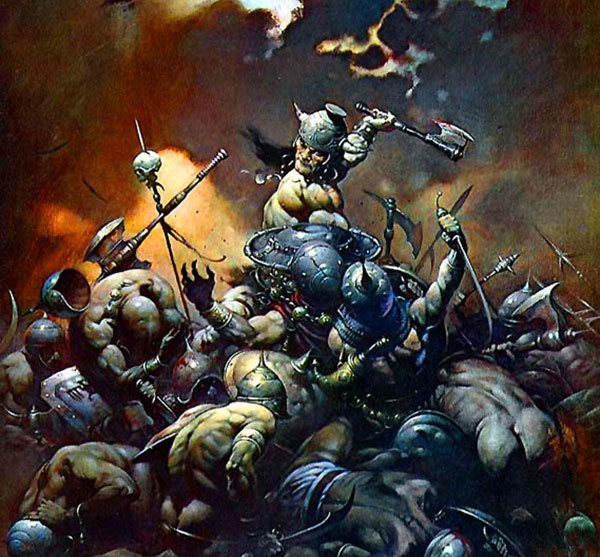
Sometimes referred to as "Low Fantasy", S&S for me is defined by the fact that Humans are the only "race" in the world, and that creatures of fantastic origins are rare, and usually at odds with humanity. Magic is dark and mysterious, and often evil by its very nature. Wielding arcane power usually requires rites and rituals and sacrifices, and the wielder is left somehow diminished, even if only temporary. The setting is usually a blend of Bronze Age and Dark Age technology, though some elements of the Middle Ages can also be included. Robert E. Howard's Hyborian Age is the prototypical S&S setting.
Urban Fantasy
In recent years, the rise of Urban Fantasy as a sub-genre dictates that it be given equal status. The idea of Urban Fantasy is usually that magic and the fantastic co-exists with modern man, in modern cities and suburbs. Generally, the fantastic is hidden from the general populace, though occasionally it is more common, and can even overlap with High Fantasy, as far as how everyday the fantastic is. I would also include in this sub-genre settings that are heavily Science Fiction, but with magical elements included, such as Steampunk. Urban Fantasy often also includes elements of horror, more so than High Fantasy, and at least as much as Sword & Sorcery. In fact, most books in the Urban Fantasy sub-genre are usually considered Horror books. Urban Fantasy doesn't seem to have a clear "patron" per se. It just sort of rose out of various other genres, and blended to create it's own niche.
You may notice, if you are well-versed in the topic, that I don't include such things as "epic" and "heroic" fantasy. That's because to me, these are not "genres" but rather methods of storytelling, related to the scope of story. Epic stories are all about saving the world, and ending with the world being changed dramatically (usually for the better). Heroic stories are more localized, and involve a smaller cast of characters. At the end of the story, the world itself has not been altered much, if at all, and any changes to the characters are usually temporary or minor. Both of these story-types can be set in a High Fantasy, Sword & Sorcery, or Urban Fantasy setting, interchangeably.
As stated, these are my definitions and interpretations, and your mileage may vary.